JULY 2026: ONE LAST PUSH NEEDED TO SAVE ST. EDMUNDSBURY FROM RESIDENTIAL REZONING!
Firstly, thank you, because the strong support from constituents and the Save St. Edmundsbury campaign and residents over the last few months made a difference. Thousands of people signed the petition, made submissions and contacted their local councillors, including me and Paul Gogarty TD.
Because of that public pressure, South Dublin County Councillors voted against rezoning the High Amenity lands at St. Edmundsbury and Finnstown for housing.
 !*** But unfortunately, we’re not over the line yet and we need YOUR help in one last push.***!
Under planning law, because the Councillors changed the draft plan, the decision now must go back out for one final round of public consultation before it can be confirmed.
This is our last chance to show that the community stands behind protecting these environmentally sensitive and ancient lands.
If we want to save St. Edmundsbury and Finnstown, this final effort is essential!
HERE’S HOW YOU CAN HELP
 1. Make a submission before Wednesday 5 August
Making a submission is quick, and every submission counts.
 Consultation Portal:
You don’t need to be a planning expert. You simply need to tell the Council that you support keeping St. Edmundsbury (and Finnstown) as High Amenity lands.
2. Tell your friends, neighbours and family
Many people still don’t realise that this final consultation is happening.
Please share this post and encourage others to get involved.
NEED HELP MAKING A SUBMISSION?
Volunteers will be calling door-to-door in Lucan to chat to residents about the issues involved and will have a sample submission for you to sign. However, you are encouraged to write your own if you can, as your own words are taken into account more positively in the decision.
Also, over the next 2 weeks, Paul Gogarty TD Public Notifications and I, Cllr Helen Farrell, will be holding a number of drop-in clinics in Lucan (definitely one on Sat 25th 10-12:30 at Starbucks Woodies) where anyone can come along to:
• Ask questions
• Understand what the consultation is about
• Get help making a submission online
You don’t need any planning knowledge; we’ll guide you through it.
WANT TO LEARN MORE?
You can read more about the proposed material alterations and view all the planning documents here:
SDCC Consultation Portal: https://consult.sdublincoco.ie/en/consultation/proposed-material-alterations-proposed-variation-no-2-south-dublin-county-development-plan-2022-2028
NOW WE NEED ONE LAST EFFORT FROM THE COMMUNITY TO HELP MAKE SURE THAT DECISION IS SECURED.
Please make your submission before 5 August, share this post and encourage others to do the same, if you need guidance on making your submission email me at hfarrell@cllrs.sdublincoco.ie
CHOOSE ONE SUBMISSION TYPE BELOW AND FILL IN YOUR DETAILS, PLEASE SEND THESE BACK TO hfarrell@cllrs.sdublincoco.ie
June 2026: What are the Chief Executive’s Final Rezoning Proposals?
June 2026: What are the Final CE Rezoning Recommendations for Lucan?
Adamstown SDZ West
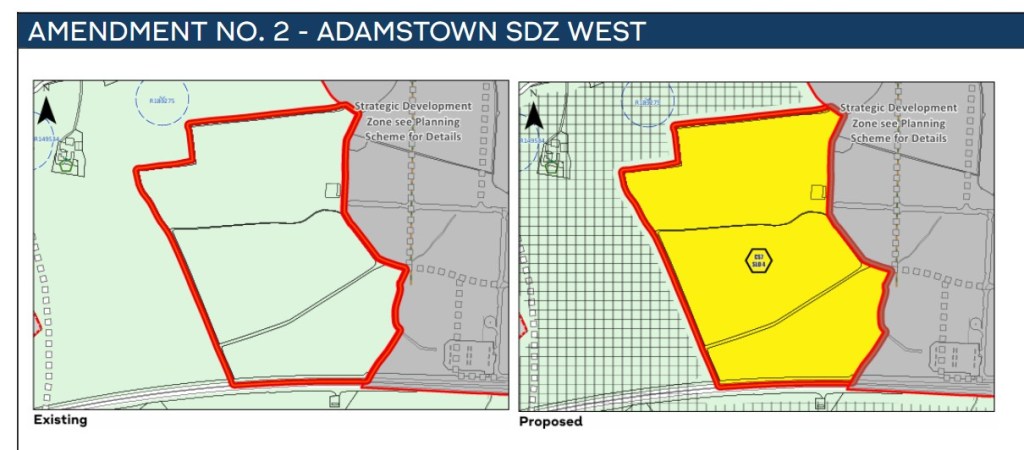
My assessment of this final rezoning proposal for Adamstown SDZ West
Concerns substantially addressed
✅ Water and wastewater
✅ Ecological mitigation
✅ Masterplanning
✅ Open space provision within the development
Concerns partially addressed
🟡 Public transport
🟡 Traffic
🟡 Education
🟡 Cumulative impacts
Concerns largely unresolved
🔴 Healthcare capacity
🔴 Landscape character
🔴 Visual amenity
🔴 Loss of strategic open land
🔴 Overall pace of development relative to existing Adamstown and Clonburris build-out
Biggest remaining issues not addressed by CE Recommendations:
Healthcare Capacity
There is no provision for healthcare infrastructure within the recommendation, despite the scale of population growth envisaged. The absence of requirements for primary care centres, GP capacity, or wider community health services creates a clear risk that essential services will lag behind residential development.
Landscape Character
The recommendations do not adequately address the broader landscape context of the lands west of Adamstown. While ecological features are referenced, there is little strategic consideration of how development will interact with the existing rural–urban transition or preserve the character of this edge-of-settlement area.
Visual Amenity
There is no explicit guidance on protecting visual amenity or managing the visual impact of development. Key aspects such as building height, density transitions, and views are deferred to future masterplanning, leaving considerable uncertainty about the eventual form and quality of the development.
Loss of Strategic Open Land
The rezoning of these lands is not accompanied by a strong strategic justification or clear mitigation measures. There is no commitment to maintaining meaningful green buffers or preserving separation between settlements, raising concerns about incremental coalescence and loss of open countryside.
Overall Pace of Development (Relative to Adamstown & Clonburris)
The absence of a clear phasing strategy linked to infrastructure delivery remains a significant gap. The reliance on a relatively weak rail trigger, combined with the lack of firm sequencing measures, creates a risk that development could proceed ahead of infrastructure and outpace the build-out of existing SDZ areas, undermining coordinated and sustainable growth.
Finnstown Castle, Lucan
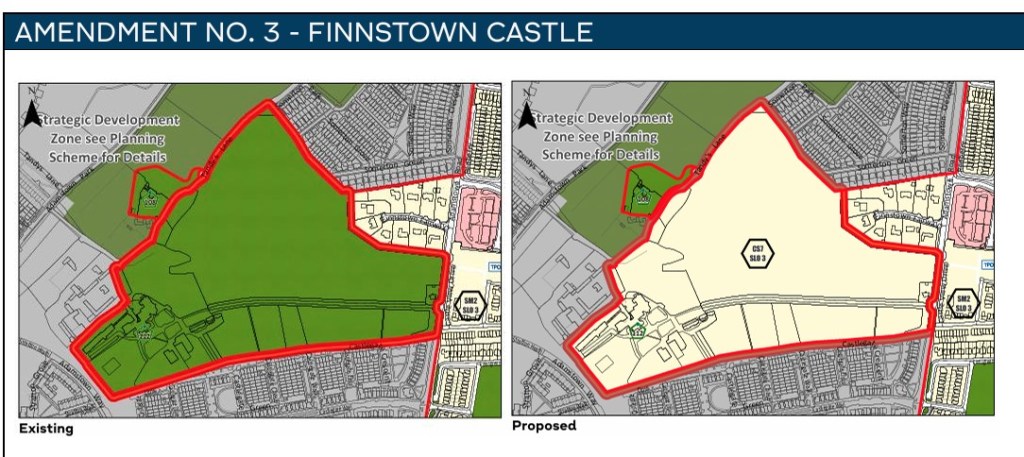
My assessment of this final rezoning proposal for Adamstown SDZ West
Concerns substantially addressed
✅ Water and wastewater
✅ Heritage setting
✅ Active travel integration
✅ Open space planning
Concerns partially addressed
🟡 Public transport
🟡 Traffic
🟡 Education
🟡 Infrastructure planning
🟡 Environmental mitigation
Concerns largely unresolved
🔴 Healthcare capacity
🔴 Community cohesion
🔴 Settlement character
🔴 Cumulative development pressure
🔴 Long-term quality-of-life impacts from continued population growth
🔴 Loss of open land and perceived overdevelopment
The Two Biggest Remaining Issues
1. Community Character and Cohesion
This was one of the principal concerns raised by the public, yet the response focuses mainly on technical planning requirements rather than how rapid cumulative growth may affect identity, sense of place, social cohesion, integration with existing communities.
2. Cumulative Growth Across the Wider Area
The SLO requires consideration of cumulative development, but it does not establish any mechanism whereby development would be paused or reduced if cumulative impacts prove excessive. In practical terms, this means the issue has been acknowledged, but not necessarily solved.
That is probably the most significant distinction between the public concerns that were raised during the recent public consultation, and the CE’s recommendations. The recommendations create processes to assess impacts, but they do not guarantee that development intensity will be adjusted if those assessments identify significant pressure on quality of life.
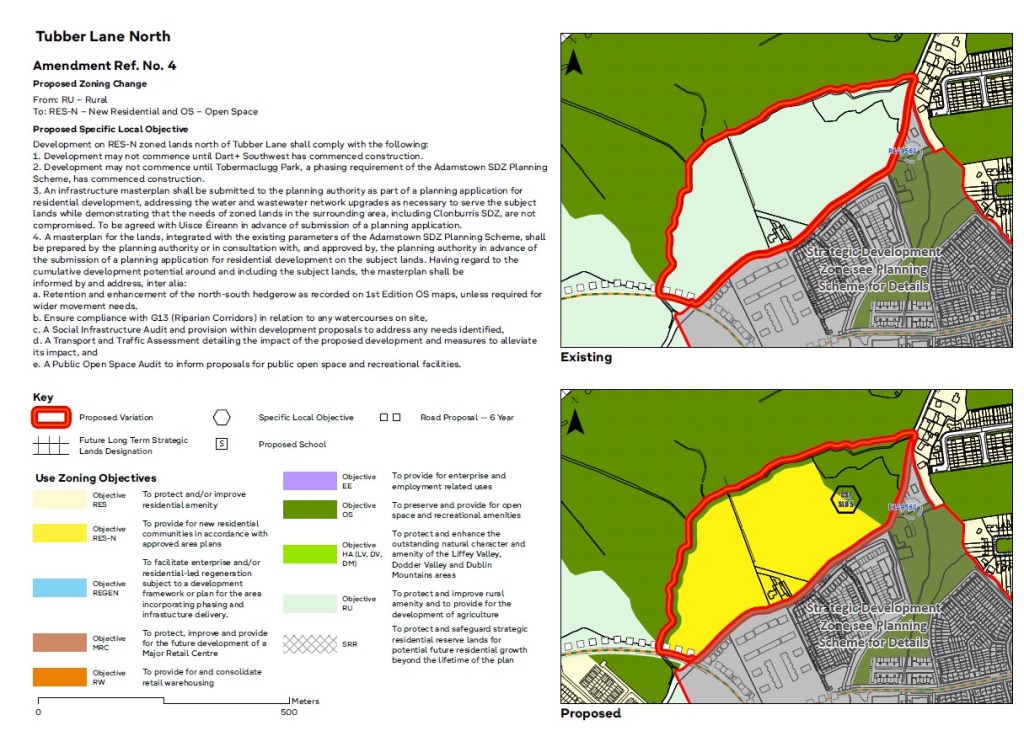
Tubber Lane North, Lucan
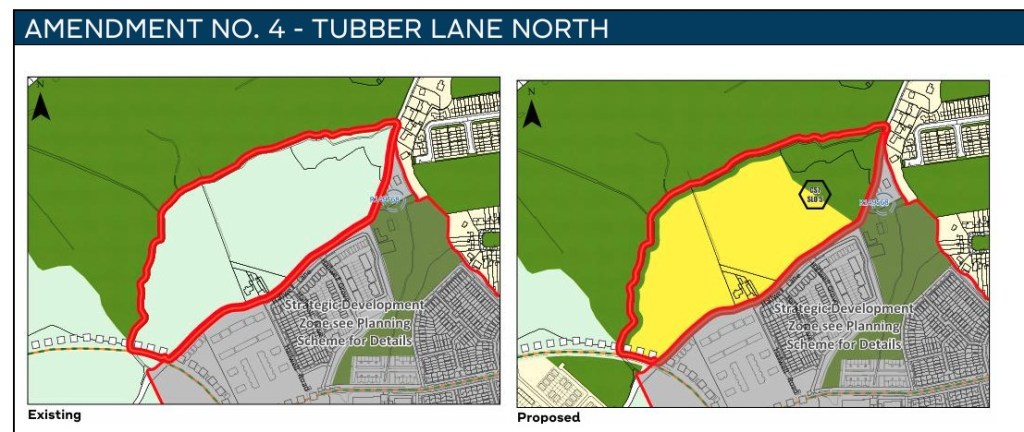
My assessment of this final rezoning proposal for Tubber Lane North
Concerns substantially addressed
✅ Water and wastewater infrastructure
✅ Public transport dependency (DART+ South West trigger)
✅ Open space planning and recreational provision
✅ Educational capacity assessment
✅ Environmental sensitivity considerations
Concerns partially addressed
🟡 Traffic and transport impacts
🟡 Infrastructure planning and coordination
🟡 Flood risk and watercourse protection
🟡 Timing of development relative to infrastructure delivery
🟡 Strategic planning and cumulative impact assessment
Concerns largely unresolved
🔴 Overdevelopment and scale of growth
🔴 Residential amenity impacts
🔴 Wider Lucan growth pressures
🔴 Community character and settlement identity
🔴 Long-term sustainability of continued population growth
🔴 Whether development should proceed at all
The Two Biggest Remaining Issues
1. Overdevelopment and Cumulative Growth
A central theme of the public submissions was that Lucan, Adamstown and the surrounding area have already accommodated exceptionally high levels of housing growth through Adamstown SDZ, Clonburris SDZ and other developments. The CE recommendation directly acknowledges cumulative development potential and requires a masterplan informed by cumulative impacts. However, it does not place any limit on the scale of development that may ultimately proceed. Instead, it requires further assessment and planning before development occurs. As a result, concerns about excessive growth have been recognised, but not fundamentally resolved.
2. Strategic Sustainability and Wider Area Capacity
Several submissions argued that the proposal lacked a sufficiently integrated, systems-based approach to balancing housing growth with environmental protection, infrastructure delivery and long-term sustainability. The recommendation introduces significant new requirements, including an infrastructure masterplan, social infrastructure audit, transport assessment, open space audit, educational capacity review and environmental safeguards. These represent a substantial strengthening of the original proposal. However, the recommendation focuses on assessing and managing impacts rather than establishing thresholds beyond which development would be reduced, delayed or prevented if wider area pressures become excessive.
That is probably the most significant distinction between the concerns raised during the public consultation and the CE’s recommendations. The recommendations create a much stronger framework for assessment, coordination and mitigation, but they do not guarantee that development intensity will be reduced if those assessments identify substantial cumulative pressure on infrastructure, services, the environment or quality of life.
Compared with Finnstown, I would say the CE has gone further here in responding to public concerns. The addition of the DART+ trigger, the Tobermaclugg Park trigger, the infrastructure masterplan, social infrastructure audit, transport assessment, open space audit and education requirements means a greater proportion of the concerns have been addressed. However, the fundamental objection raised by many submitters — that there is already too much development in the wider area — remains largely unanswered because the recommendation manages growth rather than questioning the appropriateness of further growth itself.
St. Edmundsbury, Lucan
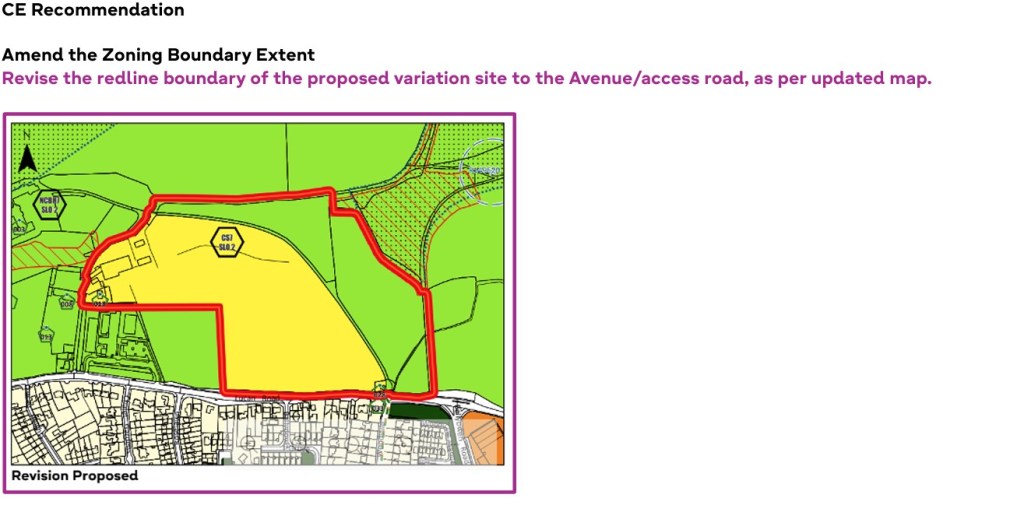
This is probably the most crucial of the rezonings because, unlike Finnstown or Tubber Lane North, the dominant public concern was not simply infrastructure capacity. The submissions were overwhelmingly focused on biodiversity, green infrastructure, landscape character, amenity value and the loss of one of the last substantial undeveloped parts of the Liffey Valley corridor.
My assessment of this final rezoning proposal for St. Edmundsbury
Concerns substantially addressed
✅ Biodiversity assessment requirements
✅ Green infrastructure protection measures
✅ Landscape and visual impact assessment
✅ Heritage and protected structure considerations
✅ Public open space provision
✅ Ecological buffering and habitat protection
✅ Wildlife-sensitive lighting requirements
Concerns partially addressed
🟡 Traffic and transport impacts
🟡 Environmental sensitivity
🟡 Loss of greenfield land
🟡 Recreational amenity provision
🟡 Ecological connectivity
🟡 Infrastructure planning
🟡 Cumulative development impacts
Concerns largely unresolved
🔴 Loss of high-amenity land
🔴 Overdevelopment and cumulative growth
🔴 Residential development within the Liffey Valley setting
🔴 Long-term pressure on Lucan’s character and identity
🔴 Whether development should occur on the site at all
🔴 Housing-led versus infrastructure-led growth
🔴 Permanent urbanisation of part of the wider landscape
The Two Biggest Remaining Issues
1. Loss of High-Amenity Land and Landscape Character
The strongest theme emerging from the public consultation was the belief that St. Edmundsbury represents one of the last significant undeveloped landscape assets in the Lucan–Liffey Valley area. Submissions consistently described the lands as an important ecological corridor, recreational resource, landscape feature and community amenity whose value derives precisely from the fact that they remain largely undeveloped.
The CE recommendation responds extensively to these concerns. It requires a major public park, ecological assessments, habitat retention, a substantial ecological buffer, woodland protection, wildlife-sensitive lighting and landscape character assessment. In addition, over one-third of the lands remain zoned High Amenity Liffey Valley rather than residential.
However, the recommendation does not remove the residential zoning itself. While it seeks to minimise and mitigate impacts, it accepts the principle that part of the site will be developed. For those whose primary concern was preserving the lands in their entirety, that concern remains unresolved.
2. Overdevelopment and Cumulative Urbanisation
Many submissions framed St. Edmundsbury not as an isolated proposal but as part of a wider pattern of growth across Lucan, Adamstown and Clonburris. Concerns centred on the cumulative loss of green space, increasing urbanisation, pressure on infrastructure and the gradual erosion of Lucan’s historic landscape setting and community identity.
The CE recommendation acknowledges these concerns indirectly through requirements for ecological protection, landscape assessment, traffic assessment and the delivery of a substantial public park. These measures are considerably stronger than those applied to many conventional residential rezonings.
However, no mechanism is introduced to assess whether Lucan has reached an overall limit of sustainable growth, nor is there any provision whereby development would be reduced or halted because of cumulative development pressures elsewhere in the area. As with the other rezonings, the response focuses on managing impacts rather than questioning the appropriateness of additional growth.
That is probably the most significant distinction between the concerns raised during the public consultation and the CE’s recommendations. The recommendations substantially strengthen environmental protection, biodiversity safeguards and public amenity provision. They clearly acknowledge that St. Edmundsbury possesses exceptional ecological and landscape value. However, they do not ultimately accept the argument advanced by many submitters that these characteristics justify retaining the lands entirely outside the development process.
Compared with Finnstown and Tubber Lane North, I would say the CE has gone furthest in responding to public concerns at St. Edmundsbury. The extensive ecological requirements, the 50-metre buffer, woodland retention, habitat protection measures, landscape assessment requirements and the delivery of a major public park represent a very significant response to the environmental and amenity concerns raised. Nevertheless, the central objection advanced by many submitters — that the lands should remain entirely undeveloped as part of the Liffey Valley green infrastructure network — remains largely unresolved because the recommendation seeks to mitigate development rather than avoid it.
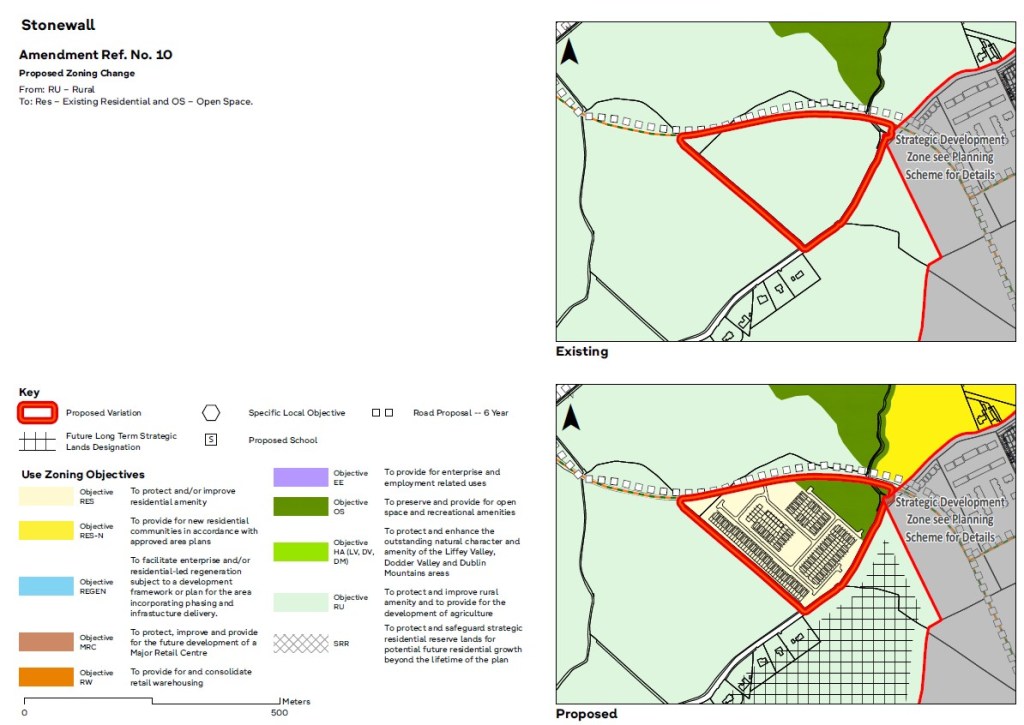
Stonewall, Lucan
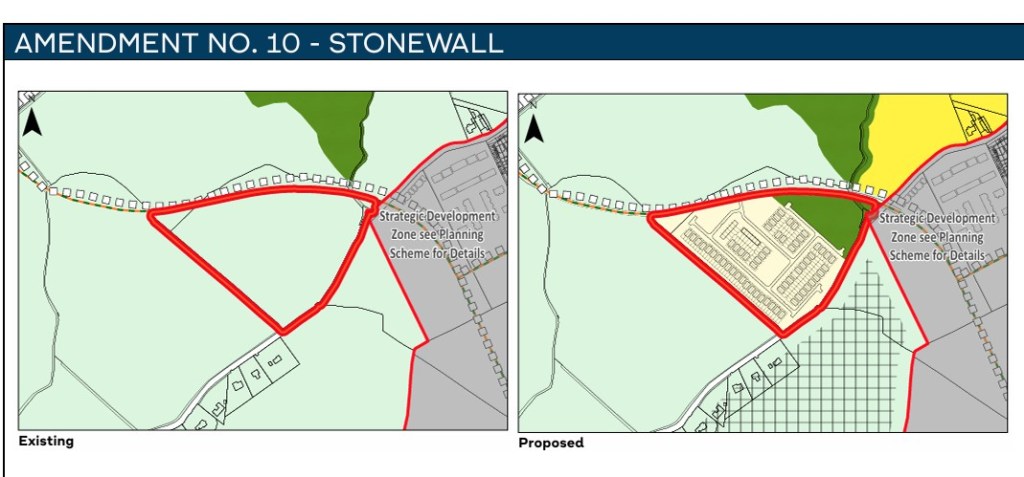
My assessment of this final rezoning proposal for Stonewall
Concerns substantially addressed
✅ Water and wastewater servicing
Concerns partially addressed
🟡 Flood risk considerations
🟡 Public transport accessibility
🟡 School capacity
🟡 Community and social infrastructure capacity
Concerns largely unresolved
🔴 Principle of rezoning temporary modular housing lands for permanent residential use
🔴 Loss of rural/open character
🔴 Retention of settlement buffer lands
🔴 Traffic congestion
🔴 Parking pressures
🔴 Overdevelopment and cumulative growth
🔴 Healthcare capacity
🔴 Community infrastructure capacity
🔴 Infrastructure-led versus housing-led development
🔴 Need for additional social infrastructure assessment
The Two Biggest Remaining Issues
1. Principle of Permanent Residential Zoning
The most distinctive concern raised in submissions was that the lands currently accommodate modular housing delivered under emergency legislative provisions and that this temporary use should not automatically justify permanent residential zoning.
Many submissions argued that the site should remain Rural (‘RU’) or be designated Open Space (‘OS’), citing its role as a green buffer between settlements and the importance of retaining open land within an increasingly urbanised area.
The CE recommendation does not directly address these concerns. Instead, it concludes that because the lands are already developed and occupied, and because they meet broader planning policy objectives, residential zoning is appropriate. As a result, the core objection raised by many submitters has largely not been accepted.
2. Overdevelopment and Infrastructure Capacity
A recurring theme throughout the submissions was that Lucan and Adamstown have already experienced significant residential growth through Adamstown SDZ, Clonburris SDZ and other developments. Concerns were raised regarding congestion, parking pressures, public transport capacity, school places, healthcare provision and wider community infrastructure.
Unlike several of the other rezoning proposals, no additional infrastructure triggers, social infrastructure audits, transport assessments or development conditions were introduced as part of the CE recommendation. The recommendation instead relies on the conclusion that the lands are appropriately located beside existing development and infrastructure.
That is probably the most significant distinction between the concerns raised during the public consultation and the CE’s recommendations. While the CE acknowledges the concerns, the recommendation does not introduce any new mechanisms to address them. Instead, it concludes that the existing planning context, infrastructure availability and policy framework are sufficient to justify the zoning.
Compared with Finnstown, Tubber Lane North and St. Edmundsbury, this is probably the proposal where the least change was made in response to public submissions. The CE recommendation largely maintains the original position that the zoning is appropriate, meaning many of the concerns raised by residents remain substantially unresolved.
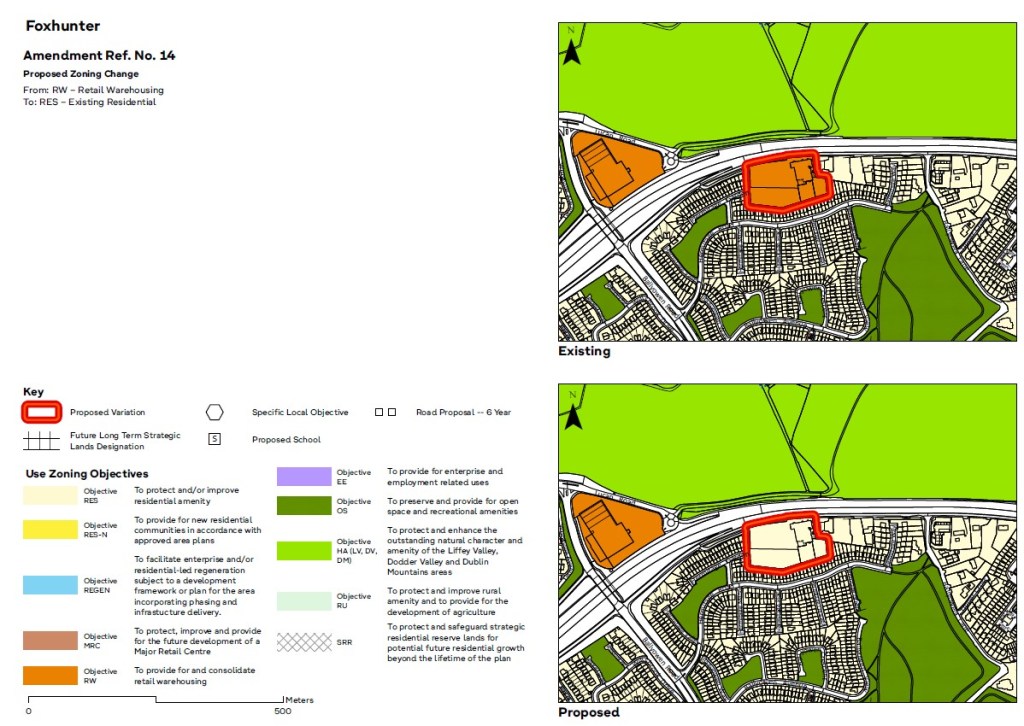
Foxhunter, Lucan
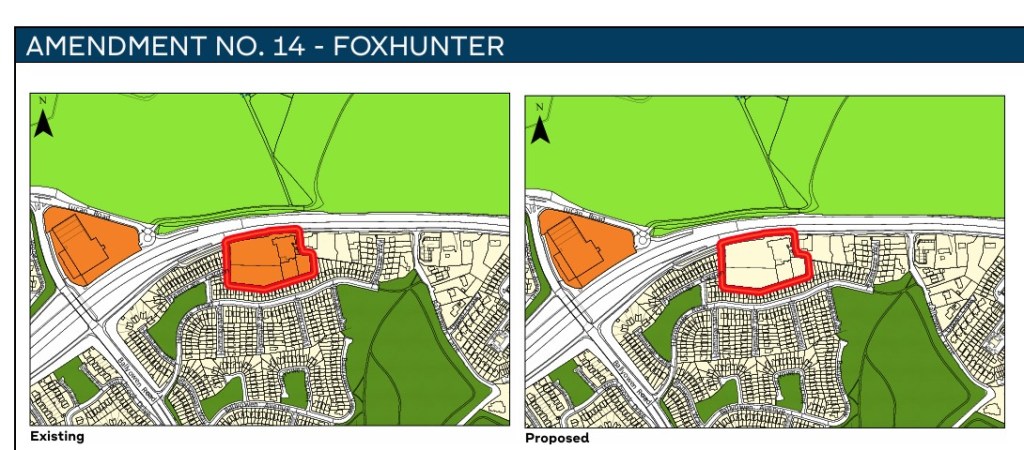
My assessment of this final rezoning proposal for Foxhunter
Concerns substantially addressed
✅ Alignment with compact growth policy objectives
Concerns partially addressed
🟡 Public transport accessibility
🟡 School accessibility
🟡 Sustainable mobility objectives
🟡 Community and social infrastructure capacity
🟡 Traffic and transport planning at a strategic level
Concerns largely unresolved
🔴 Traffic congestion
🔴 Local road capacity
🔴 Parking pressures
🔴 Healthcare capacity
🔴 Community infrastructure capacity
🔴 Overdevelopment and cumulative growth
🔴 Housing-led versus infrastructure-led development
🔴 Loss of employment lands
🔴 Jobs-to-housing imbalance
🔴 Residential amenity impacts from proximity to the N4
🔴 Potential building height and density concerns
🔴 Community cohesion concerns
🔴 Access through Hermitage Gardens and Hermitage Park
🔴 Orbital road infrastructure requirements
The Two Biggest Remaining Issues
1. Traffic, Infrastructure and Cumulative Growth
The dominant theme running through many submissions was that Lucan and Adamstown have already experienced substantial residential growth and that transport infrastructure has not kept pace. Concerns were raised regarding congestion on the N4, R136, Newcastle Road, local junctions and residential streets, alongside pressure on public transport, parking, healthcare and community facilities.
Several submissions sought specific safeguards, including a requirement that major transport infrastructure be delivered before further development proceeds, while others requested guarantees that residential streets such as Hermitage Gardens and Hermitage Park would not be used to access future development.
The CE recommendation does not introduce any additional transport triggers, infrastructure requirements, traffic assessments or access-related SLOs. Instead, it relies on broader strategic transport studies that are currently being advanced by the Planning Authority. As a result, many of the immediate infrastructure concerns raised by residents remain largely unresolved.
2. Loss of Employment Lands and Development Balance
A significant number of submissions argued that the site should retain its employment zoning rather than be rezoned for housing. Residents highlighted the importance of maintaining local employment opportunities, reducing commuting demand and achieving a better balance between jobs and housing within the wider Lucan area.
Submissions also expressed concern that continued residential growth without corresponding employment provision would deepen existing imbalances and increase pressure on transport infrastructure. In addition, some residents questioned whether the site’s location beside the N4 made it more suitable for employment-generating uses than residential development.
The CE recommendation does not directly engage with these concerns. Instead, it concludes that the lands are suitable for residential development because of their proximity to existing and planned schools, public transport infrastructure, neighbourhood centres and parks. Consequently, the argument for retaining employment zoning has largely not been accepted.
That is probably the most significant distinction between the concerns raised during the public consultation and the CE’s recommendations. The submissions focused heavily on site-specific impacts, infrastructure constraints and the cumulative effects of continued growth. The CE response, by contrast, relies primarily on wider strategic planning objectives relating to compact growth, accessibility and housing delivery.
Compared with Finnstown, Tubber Lane North and St. Edmundsbury, Foxhunter is one of the proposals where the CE has made the fewest changes in response to public submissions. No additional SLOs, infrastructure triggers, social infrastructure audits, transport requirements or development constraints have been introduced. As a result, many of the principal concerns raised by residents remain substantially unresolved within the final recommendation.
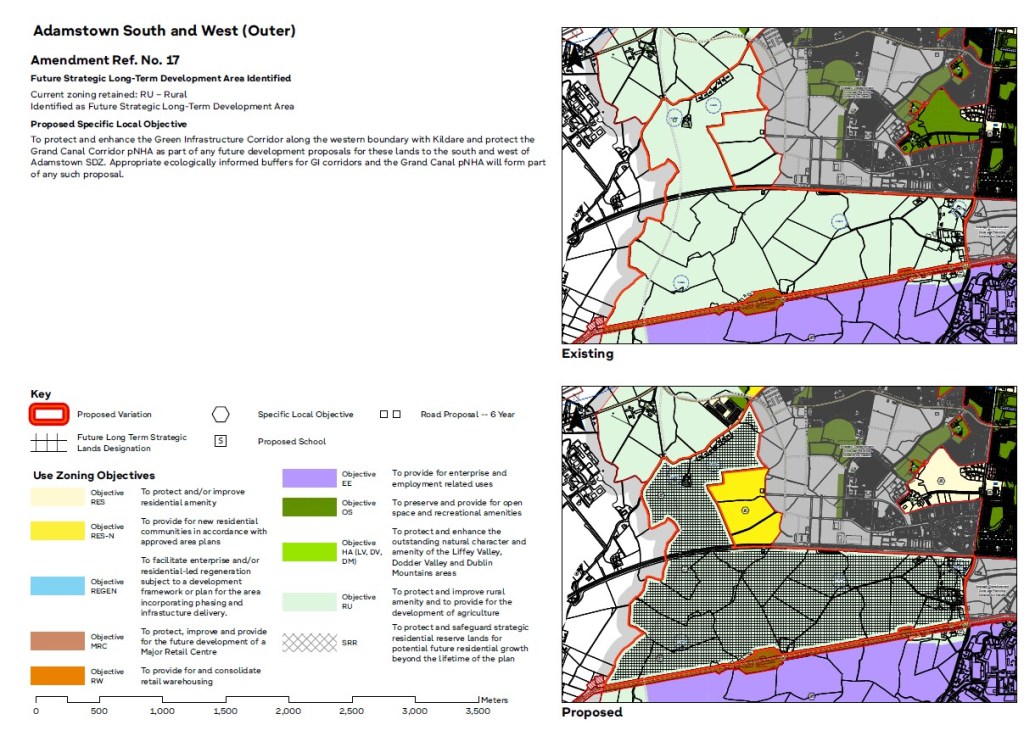
Adamstown South & West (Outer), Lucan.
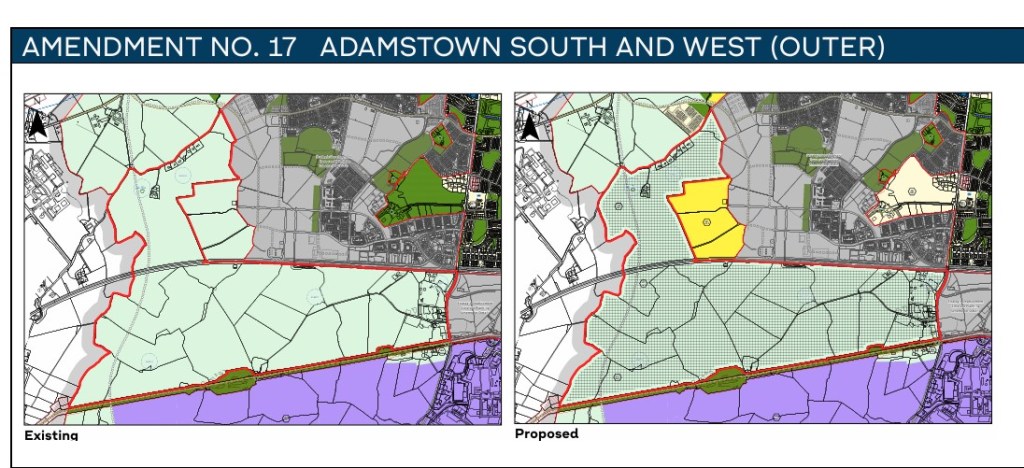
My assessment of the Adamstown South & West (Outer) Strategic Development Area proposal
Concerns substantially addressed
✅ Strategic transport planning requirements
Concerns partially addressed
🟡 Development phasing
🟡 Transport infrastructure planning
🟡 Long-term growth sequencing
🟡 Cumulative transport impacts
🟡 Future strategic planning framework
Concerns largely unresolved
🔴 Premature future development designation
🔴 Loss of greenfield land
🔴 Loss of High Amenity and landscape character
🔴 Loss of strategic green buffers
🔴 Settlement separation concerns
🔴 Overdevelopment and cumulative growth
🔴 Infrastructure-led versus housing-led development
🔴 Requirement for DART+ and other infrastructure to be operational rather than merely commenced
🔴 Open space and regional park aspirations
🔴 Community and social infrastructure capacity
🔴 Educational capacity
🔴 Healthcare capacity
🔴 Environmental protection and biodiversity concerns
🔴 Whether the lands should ultimately be developed at all
The Two Biggest Remaining Issues
1. Future Development of the Lands
The strongest theme emerging from submissions was opposition to the principle of future urban development on these lands. Many respondents argued that the area functions as an important green buffer between settlements, forms part of a wider landscape setting connected to the Liffey Valley and Grand Canal corridors, and should remain permanently undeveloped or be designated for open space, green infrastructure or regional park purposes.
The CE recommendation does not materially alter the proposed Strategic Development Area designation. While it introduces an additional transport planning requirement, it does not address the underlying question of whether the lands should ultimately transition towards urban development in the future.
As a result, the principal concern raised by many submitters remains largely unresolved.
2. Infrastructure Phasing and Timing
Phasing was one of the most consistently raised concerns throughout the consultation process. Submissions repeatedly argued that existing development within Adamstown SDZ and Clonburris SDZ has outpaced the delivery of transport, schools, parks, utilities, healthcare and community facilities.
Particular concern was expressed regarding the proposal to link future development to the commencement of infrastructure projects such as DART+ South West rather than their operational delivery. Many submissions argued that infrastructure should be fully delivered and functioning before additional strategic lands are activated.
The CE recommendation introduces a requirement for an Area-Based Transport Assessment to be undertaken with the NTA and TII. This represents recognition that transport planning will be a critical issue for any future development of the area.
However, the recommendation does not introduce any requirement that DART+, schools, roads, parks, utilities or community facilities be operational before future development can proceed. Nor does it require Adamstown SDZ or Clonburris SDZ to be substantially completed before activation of the Strategic Development Area.
That is probably the most significant distinction between the concerns raised during the public consultation and the CE’s recommendations. The submissions focused heavily on infrastructure sequencing, cumulative growth and the appropriateness of future development, whereas the CE response primarily introduces an additional transport planning mechanism rather than new phasing controls or infrastructure triggers.
Compared with Finnstown, Tubber Lane North and St. Edmundsbury, the response here is relatively limited. The introduction of the Area-Based Transport Assessment is a meaningful addition, but it addresses only a small portion of the concerns raised. The fundamental questions regarding future development, landscape protection, green infrastructure, settlement separation and infrastructure-led growth remain largely unresolved within the final recommendation.
June 2026: What Happens Next and What Are the Key Dates for Rezoning Votes?
June 2026: What Can I DO About It NOW?
Call or email all the SDCC Councillors (40) to lobby for your views to be heard at the June 2026 rezoning meetings.
20 MAY 2026 – JUST IN – CE Report on Submissions Received to the proposed Variation no. 2 to the South Dublin County Development Plan 2022-2028
What Areas in South Dublin Are Proposed for Residential Rezoning in 2026?
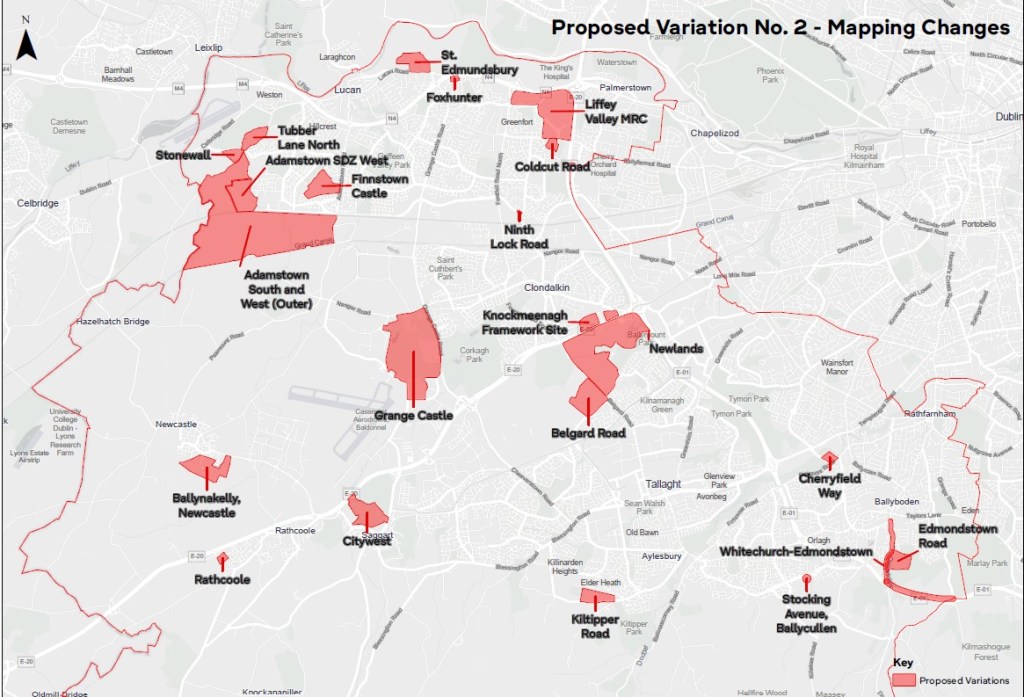
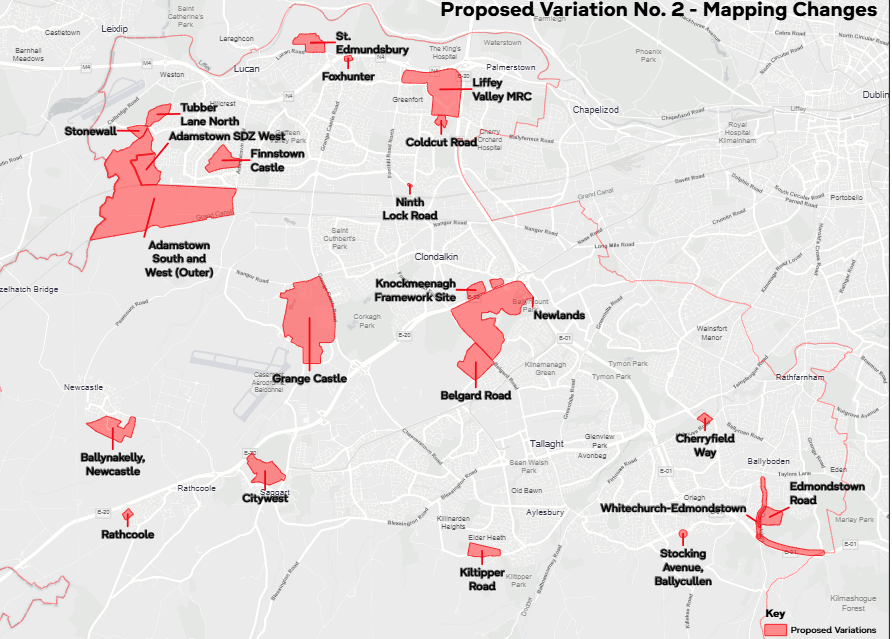
At the meeting on 4 February, 2026, the Chief Executive of SDCC and Planning Department, presented the list of areas around the county to Councillors present. Councillors did not choose these locations for potential rezoning, but we will get a final vote on whether they are rezoned for residential use, in May 2026. Of the 15 areas presented for potential rezoning, 6 were in Lucan. Areas in Lucan are in BOLD: see below.
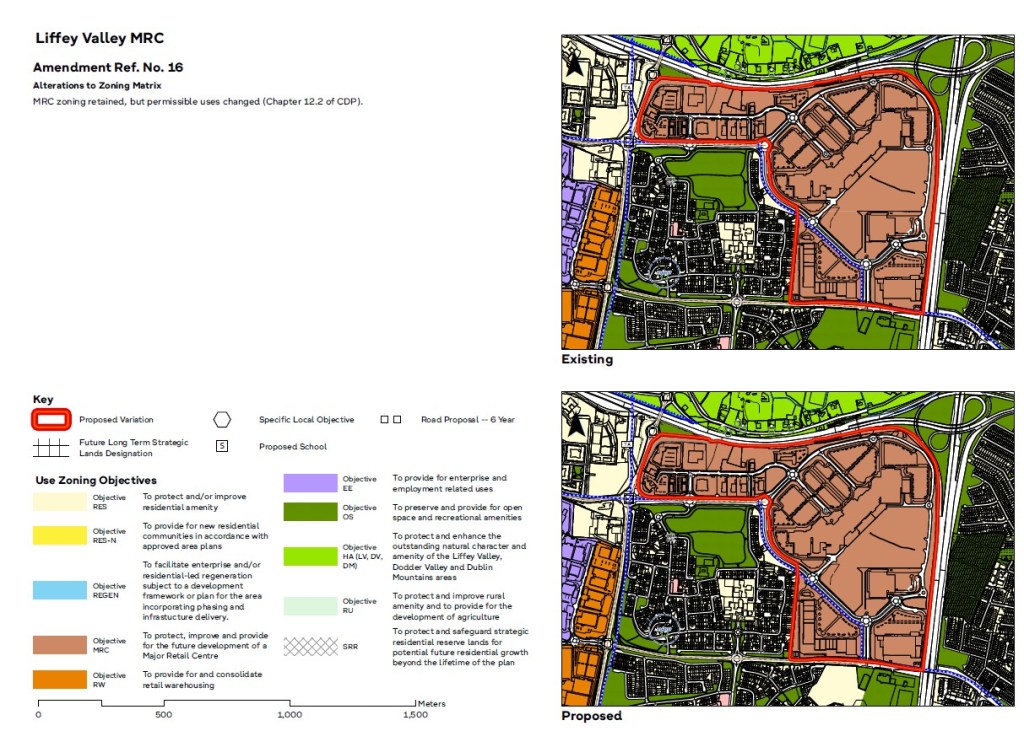
- Liffey Valley – currently zoned retail.
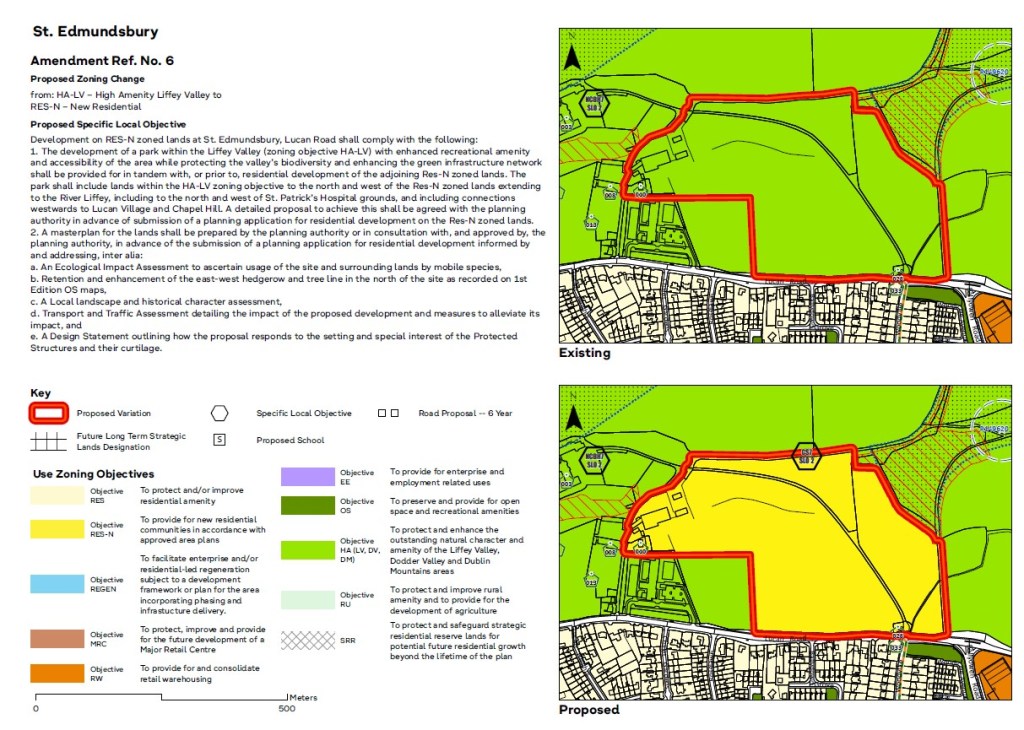
- Southern part of St. Edmundsbury – currently zoned High Amenity and adjacent to the lands that are under the SAAO of the Liffey Valley.
- Edmonstown Road – currently zoned rural.
- Kiltipper Road – currently zoned rural.
- Citywest – currently zoned Open Space. It comprises the lands in the complex that were not bought by Dept of Justice, currently a golf course.
- Ballynakelly, Newcastle – currently zoned rural. To include a public park and school site, as well as residential.
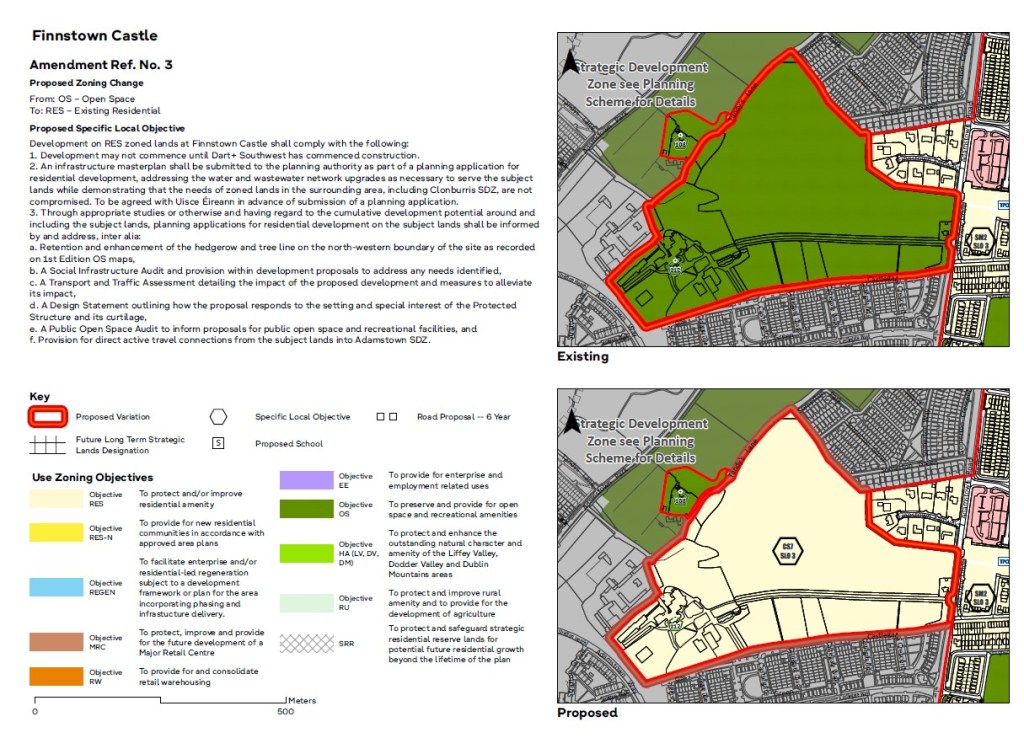
- Finnstown Castle, Lucan – currently zoned Open Space. Can only commence if Dart+ South West has commenced.
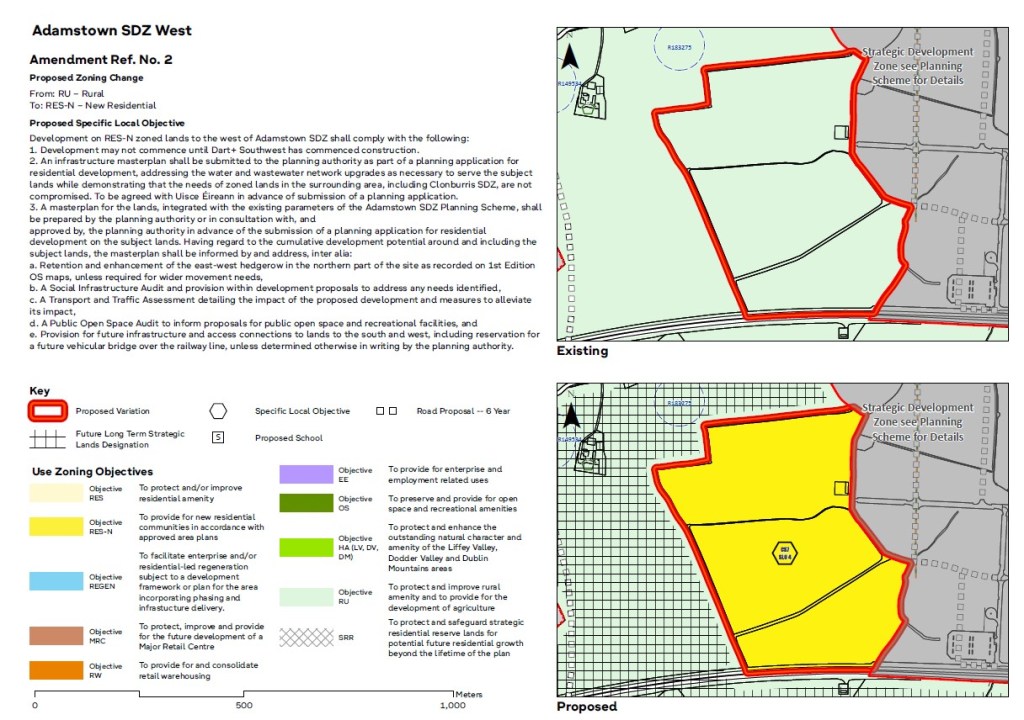
- Adamstown West, Lucan – currently zoned rural. Can only commence if Dart+ South West has commenced.
- Tubber Lane North, Lucan – currently zoned rural. To include tie into existing requirement for Tobermaclugg Park, under phase 9 of Adamstown SDZ.
- Stonewall, Lucan. A site West of Tobermaclugg currently used for emergency modular accomodation.
- Knockmeenagh – currently zoned Enterprise.
- Coldcut Road – currently zoned Open Space.
- Cherryfield Way – currently zoned High Amenity in Dodder Valley.
- Foxhunter, Lucan – currently zoned Retail/Warehousing.
- 9th Lock Road, Clondalkin; this is on the edge of Clonburris – currently zoned Open Space.
Where Can I Find Out More About This?
SDCC’s Public Consultation Portal https://consult.sdublincoco.ie/en/consultation/proposed-variation-no-2-south-dublin-county-development-plan-2022-2028 now has full plans for you to view.
You can read each rezoning proposal, with reasons why and maps using the link above. Look at the right side of the screen for the “Materials” section which lists all the documents and maps. Register for an account, as it will make it much easier for you to lodge submissions.
SDCC will be holding two drop-in open days to present the plans to the public and answer questions on the process. These dates are:
- 25 February, 2026 in County Hall, Tallaght
- 4 March, 2026 in Lucan Library, 2-8pm
What Happens Next?
On 4 February 2026, all SDCC Councillors received a briefing by SDCC Chief Executive and Senior Management to show the layout of proposed changes to the County Development Plan (areas for proposed rezoning for residential use), what legal steps have to be followed, and a short summary of what changes are being suggested — including details of exactly which pieces of land around the County might be rezoned, in order to meet the Government’s targets.
Currently, the proposal is live on SDCC’s Public Consultation Portal for six weeks of public consultation, where members of the public can send in their views. This is where YOU need to get involved! You need to lodge your submission on this proposed rezoning. You can object / support one area, or any amount of proposed areas. You can send in as detailed or as short a submission as you want, but you need to add your voice now so that SDCC can take your views into account!
When the consultation period is over, the proposal comes back to the Council. At that point, Councillors will discuss it and decide whether to accept it, amend it, or reject it. I will not be voting for rezoning in areas without sufficient infrastructure or services to support a reasonable quality of life, or in ecologically sensitive areas such as Edmundsbury.
What Can I Do About This Potential Rezoning?
You can object or support the plans on SDCC’s public Consultation Portal here – the proposal is open for submissions until 13 March 2026. Each rezoning proposal is explained in detail and you can decide if you wish to agree or disagree with it; you should make a submission to ensure your voice is heard!
You can read some of the existing submissions here if you want to get a sense of what others are writing. Your submission does not have to be a detailed report! Observations as short as an email are just as valuable as long submissions. You can send in observations as an individual, or as a group. If you register for an account, it will make it much easier to get alerts about consultations and easier for you to lodge submissions.
Myself and Paul Gogarty, TD, are happy to discuss the rezoning plans with you or with groups and resident’s associations; please contact us about this.
SDCC will also be holding two open days to present the plans to the public and answer questions on the process. These dates are:
- 25 February, 2026 in County Hall, Tallaght
- 4 March, 2026 in Lucan Library, 2-8pm – put this date in your diary!
I Want To Protest Against This Right NOW!!
I understand your stance, but right now, the most important thing to save land from being rezoned residential is to lodge your submission now (remember, it can be a basic paragraph or two, or a longer piece of writing, but just send it in!) using the SDCC Consultation Portal. Begin by registering as a new user.
If you don’t send in your submission, your silence may result in rezoning that will be impossible to ever roll back on!
What Are the Crucial Dates Around These Rezoning Proposals?
- 4 March, 2026 in Lucan Library, 2-8pm – put this date in your diary!
- 13 March, 2026 Public Consultation Deadline
- May, 2026 proposals go before SDCC Councillors for a vote
Suggested Submission: Template For Your Use
It’s important you make your voice heard in this process. If you feel as I do, that the proposals for Lucan rezoning are either inappropriate locations (St. Edmundsbury / Finnstown) or excessive (Adamstown South & West extensions), then the template below might be a good starting point for you to customise:
When you have written / customised your submission, you follow the following steps. Written submissions or observations may be made between Friday 13th February 2026 to Friday 13th March 2026 (inclusive) in one of the following ways:
- Through the online consultation portal at Create Your Submission | South Dublin County Council’s Online Consultation Portal OR
- By post to: Variation No. 2, Senior Executive Officer, Forward Planning Section, Planning and Transport, South Dublin County Council, County Hall, Tallaght, Dublin 24, D24 A3XC
All valid written submissions or observations with respect to the Proposed Variation No. 2 and accompanying documents, made within the above stated period, shall be taken into consideration by the Council before the making of the Variation.
In respect of making a submission or observation please note the following:
Email submissions and late submissions will not be accepted.
Children, or groups or associations representing the interests of children, are entitled to make submissions or observations.
All submissions or observations should include your name and a contact address and, where relevant, details of any organisation, community group or company etc., which you represent.
Submissions and observations should be made in one medium only i.e. hard copy by post or via the consultation portal.
Need Help With Making a Submission On Rezoning Proposals?
Don’t know where to start with making a submission? Email me at hfarrell@cllrs.sdublincoco.ie or DM me on WhatsApp 087-2794936. I can help you with the submission, give you more info, give you some suggested wordings, or meet you in person at one of my drop-in cafe clinics in the Lucan area (weekend and evening times available). Alternatively you can read some of the existing submissions here to get some inspiration.
What was the NPF meeting on 4 Feb 2026 about and how might it affect rezoning in Lucan?
View my 3 February 2026: video update on potential rezoning in our County (3.25 mins)
A Stark Look at Housing Delivery Across Dublin’s SDZs
When you examine the figures, it becomes evident that South Dublin County Council carrying a disproportionately large share of new housing delivery compared with other Dublin Local Authorities, largely due to the scale of development within the Adamstown and Clonburris Strategic Development Zones (SDZ’s). As of February 2026, there are still approximately 12,000 homes left to be delivered before these SDZs are fully built.
This figure does not include the additional rezoning proposals now being considered. If approved, these could increase the total number of housing units across Adamstown and Clonburris to roughly 20,500 units. In Adamstown alone, this may add a further 4,000 residents on top of the already‑planned population of 25,000, but without additional infrastructure.
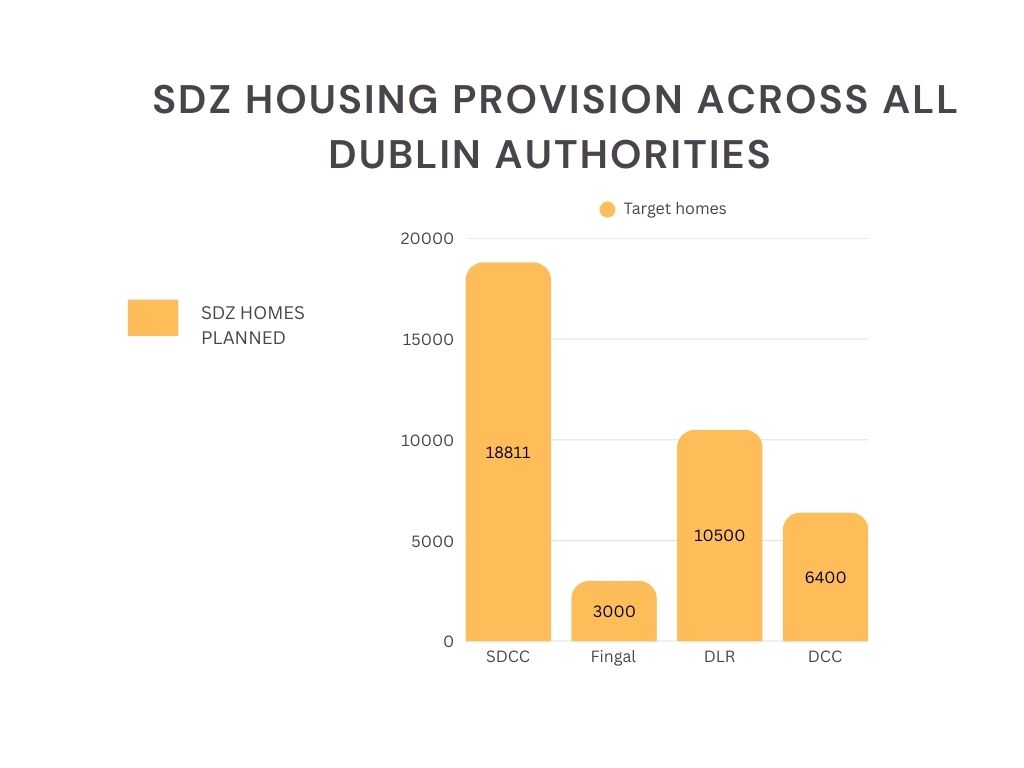
(Image: Bar chart showing data from the SDCC Housing Supply Monitor & other sources, for total planned housing units in SDZ’s within each Local Authority in the Dublin Region.)
Here are the facts:
🟦 South Dublin County – ADAMSTOWN SDZ
- Target: 9,395 homes
- Delivered to Date: c. 5,100
- Remaining (to hit target): c. 4,214
🟦 South Dublin County – CLONBURRIS SDZ
- Target: 9,416 homes
- Delivered to Date: c. 800
- Remaining (to hit target): c. 8,624
📌 Note: SDZ Planning Schemes provide a range for homes — these targets represent the mid‑point.
📌 Delivered to Date Source: SDCC Housing Supply Monitor.
🔍 How This Compares to Other Dublin Local Authorities
While SDCC’s two SDZs together total 18,811 planned homes, here is the scale of SDZs in neighbouring local authorities:
🟩 Dún Laoghaire–Rathdown – Cherrywood
- c. 10,500 homes
(maximum permissible within the SDZ)
🟥 Dublin City – North Lotts & Grand Canal Dock
- c. 2,600 homes
(target within the SDZ)
🟥 Dublin City – Poolbeg West
- c. 3,800 homes
(maximum permissible)
🟧 Fingal – Hansfield (Blanchardstown)
- c. 3,000 homes
(target within the SDZ)
⚖️ The Reality
When you put these side by side, the picture is very clear:
➡️ SDCC’s SDZs alone account for far more housing than any other council area in Dublin.
➡️ Clonburris and Adamstown together exceed the combined totals of multiple SDZs elsewhere.
SDCC Visuals of Lucan Areas for Proposed Rezoning
See the SDCC Book of Maps (PDF) for the proposals below, or alternatively, you can view “Materials” on the right side of this screen for all the official SDCC documents related to the rezoning proposals.